
Order Management
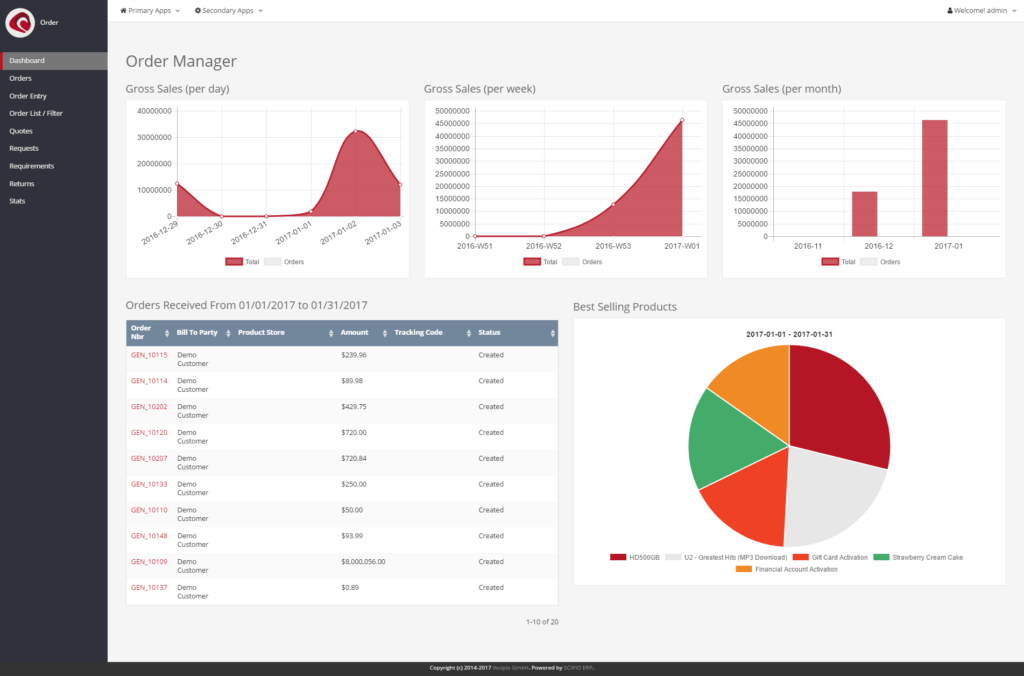
The order management application (“Order”), features all things related to orders, quotes, requests & returns. The application is split into:
- Orders (Order Lookup Screen) – (to be merged with “order list” in a future release)
- Order Entry (Order Creation)
- Order List / Filter (List of orders)
- Quotes (price offers)
- Requests (questions raised by customers)
- Requirements (Requirement management )
- Returns (products returned to company)
- Stats (order statistics; gross sales)
Before heading over to the individual screens, it may be important to understand a few underlying concepts:
There is a distinction between sales orders and purchase Orders. Sales orders are orders placed by customers, whereas a purchase order is one where the company itself is ordering products from a supplier. Regardless of the type of an order, orders go through a lifecycle, which can be visualized as the following:

The above is of course only a simplification. In reality, both the orders can be in quite different states, for example “order hold”, “order cancelled”, “order rejected”,”return cancelled”, “return manual refund” and so on. But the concept should be clear: there is a certain lifecycle attached to an order and a return and depending on the state the system is expected to do certain things. This concept is important to understand, as one can make use of it later-on to notify users, or screen the progress. The same is true for requests and quotes and the many subprocesses (like payment, shipment) also.
Backorders can also be registered: backorders in Scipio ERP are by definition orders which have been partially shipped. A service checks the ship groups and validates for every order whether or not all order items have been shipped or not. A flag is set on the order, turning “isBackOrder” to true if not all orde items have been completed. A notification email will automatically be sent to the customer and a reservation for the order Item will be made. The reservations are checked again when a future shipment is made and the original order will be updated, when all order items are shipped successfully.
Multi-Channel support is also embedded into the order process. On a database level, multiple sales channels can be configured. Each order is attributed to the appropriate sales channel as part of the order header information.
Each sales channel can be configured individually. By default, Scipio ERP has a set of sales channels preconfigured:
- Order Sales Channel
- Web Channel
- POS Channel
- Fax Channel
- Phone Channel
- E-Mail Channel
- Snail Mail Channel
- Affiliate Channel
- Order Sales Channel
- Ebay Channel
The application in 4.0#
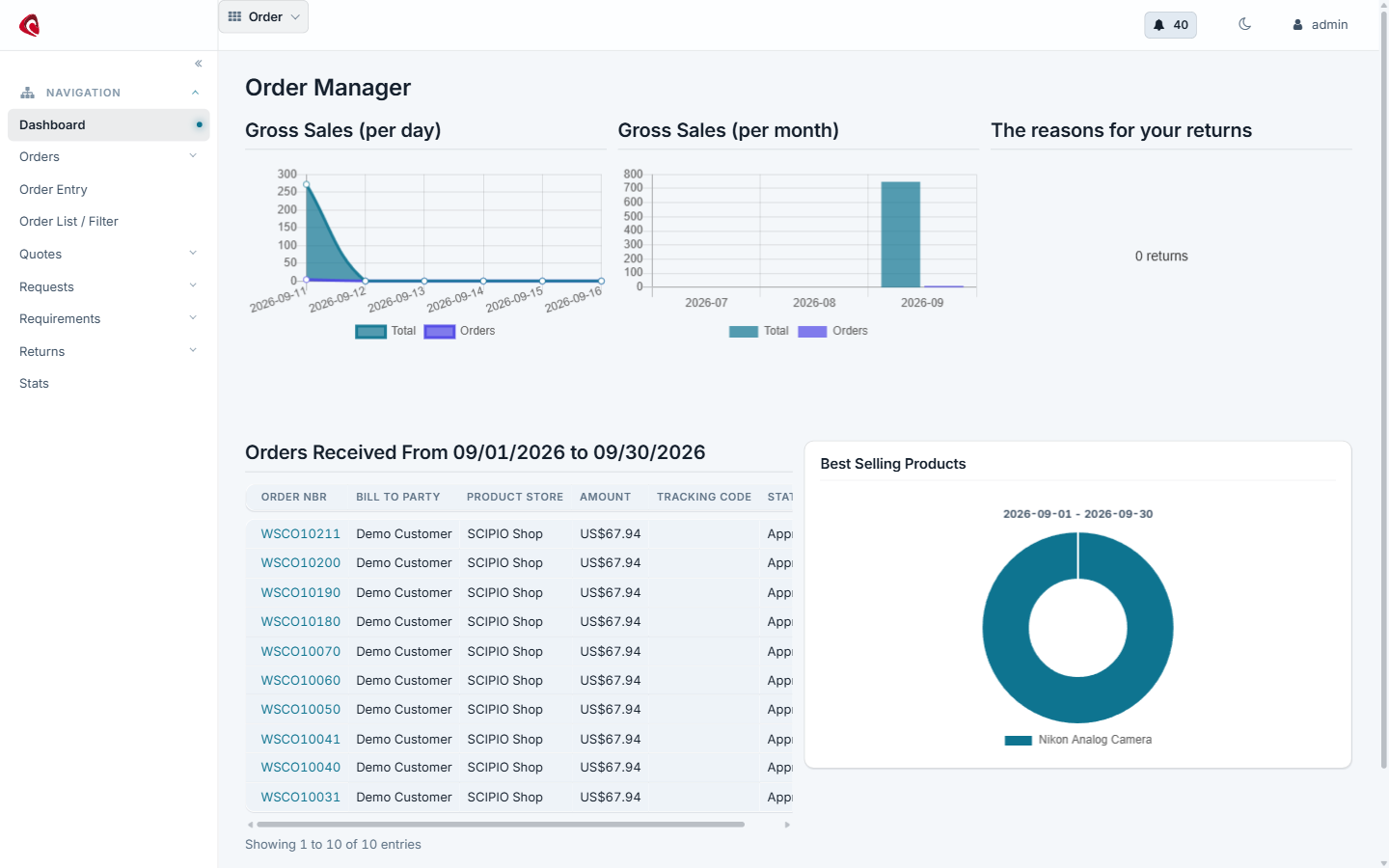
The order manager in 4.0: gross sales per day and per month, the orders of the current month and the reasons behind the returns.
Do it with an agent#
Order management ships an MCP server. Point your agent at the order webapp and it takes an order from entry to shipment.
claude mcp add --transport http scipio-order "https://<host>/ordermgr/mcp" --header "Authorization: Bearer <token>"Three tools carry the application. Every call names the tool and one action.
order—create,find,get,approve,set_status,item_add,item_set_status,payment_add,payment_capture,payment_refund,payment_release,ship,ship_group_update,shipping_method_set,pick_list_create,invoice,note_add,return_create,return_set_status.purchase_order—create,complete,send,requirement_create,requirement_assign_supplier,requirement_approve.quote—create,set_status,request_create,request_set_status.
From entry to the packing table#
“Create a sales order for Demo Customer with ten Nikon Analog Cameras, approve it, capture the card and start a pick list.”
The agent calls order:create, order:approve, order:payment_capture and
order:pick_list_create. Money moves only on a confirmed call, so the capture
stops and asks.
Take a return back#
“Take two units back from order WSCO10040, approve the return and refund the card.”
The agent calls order:return_create, order:return_set_status and
order:payment_refund. The refund is a confirmed call.
Turn demand into purchase orders#
“Group this week’s requirements by supplier, approve them and send the purchase orders.”
The agent calls purchase_order with requirement_assign_supplier,
requirement_approve, create and send. The manufacturing application
writes those requirements when MRP proposes a purchase.
The token is a user login. The agent does what that user may do, and nothing more. Every call writes one audit row. Read the security model before you hand a token out.