
Scipio ERP 4.0: annotations, agent access, manufacturing, Aurora
Scipio ERP 4.0 is out. We moved every definition from XML to Java annotations, reviewed and updated every application, gave each one an MCP server for the agent you already use, rebuilt manufacturing and replaced the backend theme with Aurora.
Scipio ERP 4.0 is the biggest release we have done. Between the 3.0.0 tag and the 4.0.0 tag, 6,401 files changed. We went through every application, one by one, and asked the same question each time: would we build it like this today? Quite often the answer was no.
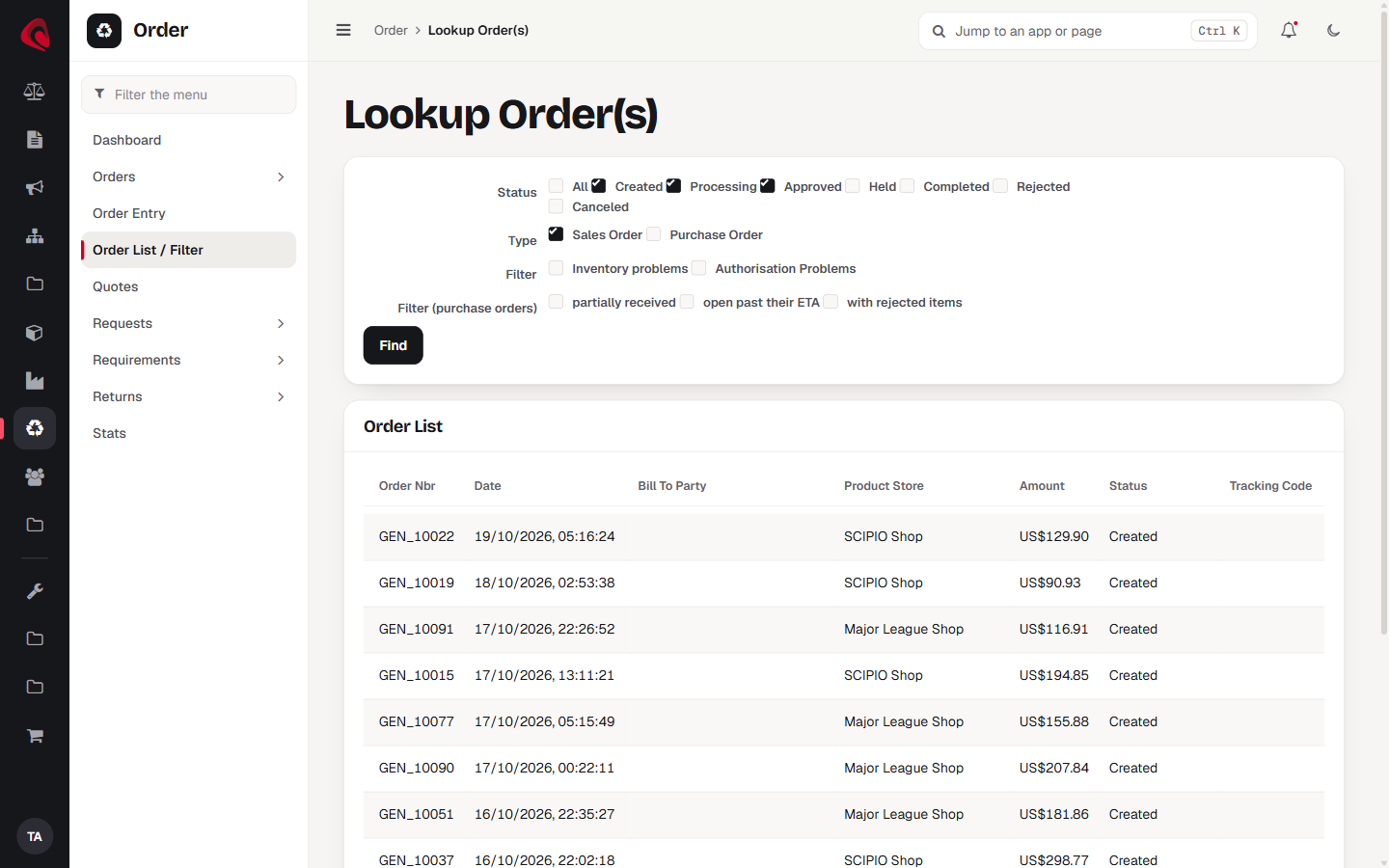
That is the order list in the new backend. The rest of this post is what changed underneath it.
The XML is gone. Everything is an annotation.#
Since 3.0 a service could be a @Service annotation instead of a
<service> element. In 4.0 the annotations cover every definition kind:
services, entities and view entities, controllers with their requests, views
and events, and the widgets: screens, forms, menus and trees. One language,
one file, and your IDE completes it.
Every application we ship is converted. Three XML files are left on purpose: the order workflow definition, and the service triggers and one entity model of the commerce profile. Your own XML still loads, and one Gradle task moves a component over when you are ready:
./gradlew convertXmlToAnnotation -Pcomponent=<name>The reference is in the developer documentation: Annotations . A step-by-step conversion of one component follows on 24 November.
Agent first#
This is the part we care about most. Every application ships its own MCP server, 18 of them, from accounting and orders to the CMS, the catalog and the shop floor. Claude Code, Claude Desktop, Cursor or VS Code connect to the application’s endpoint and work in the system the way a person works in the screens. Sixteen skills ship with them, short instructions that tell the agent how a job is done in Scipio.
The rule behind it is simple. A token is a user login, with exactly that
login’s permissions and not one more. Everything is denied unless a
permission allows it, every call writes an audit row, and executable code
needs its own permission. Every login also has a rate limit: 120 calls a
minute and four at once by default, set in
mcp.properties
.
Honest limit: the agent screens in Webtools are gone in 4.0, and the guide for making a token without them is not written yet. It is next on our list. Until then, Bring your agent explains the model.
Manufacturing, rebuilt#
We reviewed, rated and rebuilt the manufacturing application. The core was sound: production runs on work efforts, multi-level bills of material, routings on fixed assets, calendars and MRP. The rest was thin. 4.0 adds fourteen screens, twenty-two services, four entities and twelve agent tools, and removes the last Minilang from the application:
- A dashboard, the shop floor, work centre load per machine and per line.
- MRP per plant, purchase proposals that start earlier by the supplier’s lead time, make-or-buy with the preferred supplier, and a hand-over of the buy proposals to the order application.
- A bill-of-material structure panel that explodes the tree level by level, AND rules, scrap factors, where-used.
- Production lines with member machines; the operator picks the machine on the shop floor.
- Fabrication orders that group production runs and derive their status.
- A label sheet per run with a Code 128 barcode per task; scan to start, complete or declare.
- Standard, actual and variance cost per task and per run.
A three-level bicycle scenario ships with the release: five work centres, a welding cell with a robot and a manual bay, a 500 kg steel coil, a sales order and run history. We walk one order through it on 8 December. Until then, read Manufacturing .
Aurora#
The backend has a new default theme. Aurora is built without a CSS
framework and ships a light and a dark scheme. Every screen of the
demo
runs on it (login admin / scipio).
Since the tag#
The 4.0 branch kept moving after the release:
- E-invoicing to EN 16931: XRechnung, ZUGFeRD / Factur-X and Peppol BIS 3.0, sending and receiving.
- Country packs for Germany, Austria and the US. A pack brings the legal page templates (imprint, terms, privacy), the withdrawal and return periods, the tax notes for the invoice and a list of setup tasks for a new store.
- Returns with a seller refund, product archive and delete (refused once a product has orders), image order and removal, and shipping rates per facility, all of them as agent tools too.
- An event outbox, so a marketplace connector picks up order and stock changes from one queue.
Also in 4.0#
- Java 11, 17 and 21, and a Gradle build with the Kotlin DSL. Ant is gone.
- The IntelliJ plugin completes and validates the annotations.
The source is on GitHub , under the AGPL-3.0 (what that means for your shop ). A commercial license is available for a fixed €4,800 per production instance and year. Scipio ERP 3.x and earlier stay under the Apache License 2.0. If you are on 3.x, an upgrade checklist goes out next week.
More news
- Release
Scipio ERP 4.0 is AGPL-3.0: what that means for your shop
Scipio ERP 4.0 moves from the Apache License 2.0 to the AGPL-3.0, with a commercial license beside it. Five common cases, from running the shop unchanged to selling a product built on it, …
- Functions & Services
New: Maileon Integration Addon
Professional, GDPR-compliant email marketing with Scipio ERP and Maileon.
- Release
Scipio ERP 3.0.0 Released
Scipio ERP 3.0.0 has been released! This version represents an evolution of framework language and API enhancements meant to improve extensibility and reuse of framework components by client …